
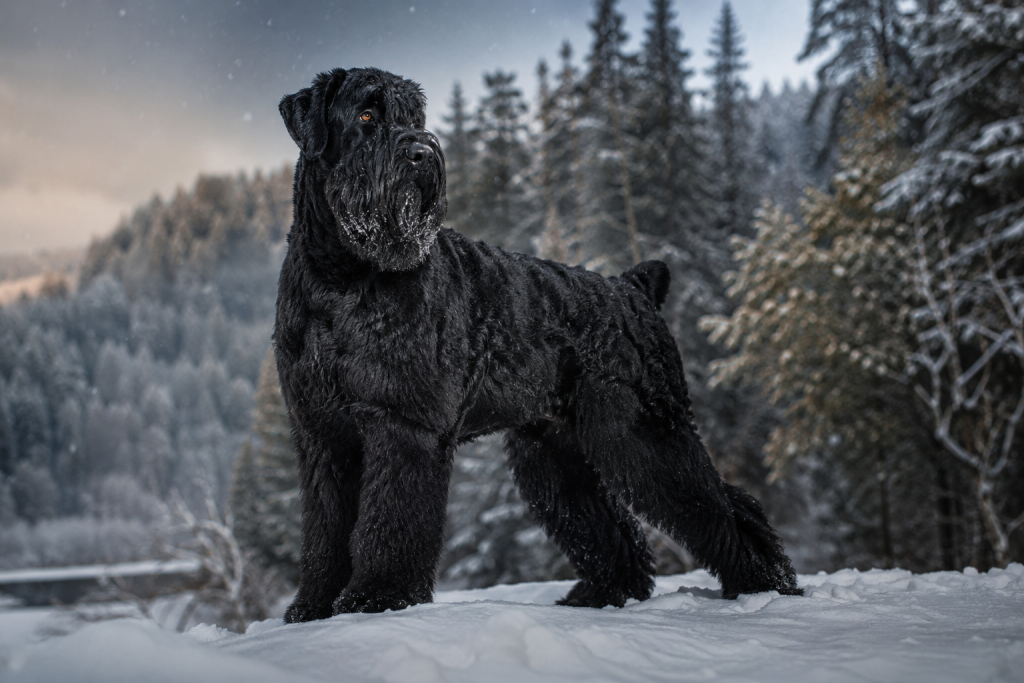
Quick Answer: The Black Russian Terrier is a large, powerful working dog developed in the Soviet Union during the late 1940s and 1950s for military and guard duties. Males stand 27–30 inches tall and weigh up to 130 pounds. Despite the name, this breed is not a true terrier — it’s a loyal, intelligent canine companion that thrives with experienced owners who can provide firm training, consistent socialization, and daily exercise.
Key Takeaways
- The Black Russian Terrier was bred by the Soviet Red Star Kennel using Rottweilers, Giant Schnauzers, Airedale Terriers, and Newfoundlands
- The American Kennel Club officially recognized the breed in July 2004, placing it in the Working Group [2]
- Males weigh 80–130 pounds and stand up to 30 inches tall — this is a genuinely large dog [3]
- Despite a calm demeanor, this breed needs an experienced owner; it is not ideal for first-time dog owners
- Early socialization is non-negotiable — without it, aloofness toward strangers can become a problem
- Their dense double coat requires brushing several times per week and professional trimming every 6–8 weeks
- Common health concerns include hip dysplasia, bloat, and progressive retinal atrophy, with a lifespan of 10–12 years [4]
- Black Russian Terriers can adapt to different climates, including cold environments, thanks to their weatherproof coat [7]
- Apartment living is possible but challenging given their size and exercise needs
- A puppy from a reputable breeder typically costs between $1,500 and $3,500

What Exactly Is a Black Russian Terrier Breed?
The Black Russian Terrier is a large working dog breed, not a true terrier despite its name. The AKC classifies it in the Working Group, and the breed was engineered — rather than naturally developed — by Soviet military scientists [6].
The breed was created at the Red Star Kennel in the USSR during the late 1940s and early 1950s. Scientists crossed more than 17 breeds to produce the ideal military dog, with the Rottweiler, Giant Schnauzer, Airedale Terrier, and Newfoundland contributing the most to the final result [5]. The goal was a dog that could work in extreme cold, guard military installations, and follow complex commands.
The name “terrier” was applied because of the dog’s working lineage and tenacious character, not because it shares traits with traditional terrier breeds like the Airedale Terrier or Welsh Terrier. Think of the Black Russian Terrier as a purpose-built guardian that happens to carry “terrier” in its title.
Where Did Black Russian Terriers Originally Come From, and What Jobs Were They Bred For?
The Black Russian Terrier originated in the Soviet Union, developed specifically for state military and working purposes. The Red Star Kennel — a government-run breeding facility — created this breed to serve as patrol dogs, guard dogs, and military working dogs across the vast and often frigid Soviet landscape [5].
Their jobs demanded a specific combination of traits:
- Physical toughness: The ability to work in harsh Russian winters
- Intelligence: Following complex handler commands without constant repetition
- Protective instinct: Guarding military installations and prisoners
- Trainability: Adapting to various working roles as needed
The breed’s weatherproof, water-repellent double coat allowed it to operate in some of the coldest regions on earth [8]. After the Soviet Union dissolved, the breed gradually transitioned from military use to family protection and companion roles. For more on other remarkable breeds from the region, explore our guide to Russian dog breeds.
How Big Do Black Russian Terriers Get?
Black Russian Terriers are genuinely large dogs. Males typically stand 27–30 inches at the shoulder and weigh between 80 and 130 pounds. Females are slightly smaller, measuring 26–29 inches tall, though their weight range overlaps significantly with males at 80–130 pounds [3].
Full physical maturity is usually reached between 18 months and 2 years of age, though some males continue to fill out until age 3. Prospective owners should plan for:
| Measurement | Male | Female |
|---|---|---|
| Height | 27–30 inches | 26–29 inches |
| Weight | 80–130 lbs | 80–130 lbs |
| Maturity Age | 18 months–3 years | 18 months–2 years |
Common mistake: Underestimating how much space this dog needs. A 130-pound dog with a thick coat and high energy requires more room, more food, and more grooming investment than most people anticipate.
Are Black Russian Terriers Good Family Dogs, and Are They Good With Kids?
Black Russian Terriers are devoted to their families and can be excellent family dogs — but only in the right household. They are calm, confident, and deeply loyal to the people they consider their pack [4]. With children they have been raised alongside, they are typically gentle and protective.
That said, a few conditions apply:
- Supervision with young children is essential. Their large size means they can accidentally knock over a toddler, even during friendly play.
- Early socialization determines everything. A well-socialized Black Russian Terrier that grows up with kids tends to be a patient, watchful guardian. One that has been isolated can become overly protective or anxious.
- They are not a “hands-off” family dog. This furry friend needs active engagement from every family member, not just one primary handler.
For families with older children who understand how to interact respectfully with a large dog, the Black Russian Terrier can be a deeply rewarding canine companion. If you have very young children and are a first-time dog owner, consider whether a less intense breed might be a better starting point.
Are Black Russian Terriers Aggressive or Friendly?
Black Russian Terriers are not inherently aggressive, but they are naturally aloof with strangers and have strong protective instincts. A well-raised, properly socialized Black Russian Terrier is calm, confident, and friendly with people it knows — but it will not greet every stranger with a wagging tail [4].
This distinction matters:
- With family: Affectionate, loyal, and playful
- With known friends: Warm and accepting once trust is established
- With strangers: Reserved, watchful, and sometimes suspicious
The breed’s guarding instinct is a feature, not a flaw — but it requires management. Without early and consistent socialization, that wariness can tip into territorial behavior. Owners who want to understand how protective instinct plays out across similar breeds may find our article on whether Bull Terriers are aggressive a useful comparison point.
How Much Training Do Black Russian Terriers Need?
Black Russian Terriers need significant, ongoing training — this is not a breed that runs on autopilot. They are highly intelligent, which means they learn quickly but also get bored with repetitive drills [4]. Breed-specific training that keeps sessions varied and mentally stimulating works best.
Training priorities for this breed:
- Basic Commands: Sit, stay, heel, and recall must be rock-solid before moving to advanced work. Start these from 8 weeks of age.
- Socialization: Expose your dog to different people, dogs, sounds, and environments during the critical window of 8–16 weeks.
- Leash manners: A 130-pound dog that pulls is a safety issue. Leash training is non-negotiable.
- Boundary work: Teach your dog what areas and behaviors are acceptable in the home early on.
Positive, effective dog training methods work well with this breed. They respond to reward-based approaches and a calm, consistent handler. Harsh corrections tend to backfire — this dog has a long memory and a strong will. For a practical framework on structured training, our 9 proven ways to train your American Pit Bull Terrier article covers positive reinforcement principles that apply across large, intelligent breeds.
Can Black Russian Terriers Live in Apartments?
Apartment living is possible for a Black Russian Terrier, but it comes with real challenges. Their adaptability to different climates is an asset [7], but their size and exercise requirements mean apartment life only works if owners commit to multiple long daily walks and regular off-leash time.
Choose apartment living with a Black Russian Terrier if:
- You can provide at least 60–90 minutes of vigorous exercise daily
- You have access to a nearby park or open space for off-leash runs
- You can manage a large dog in shared hallways and elevators
- Your dog has been well-socialized to reduce reactive behavior in tight spaces
Reconsider if:
- You work long hours and cannot provide consistent exercise
- Your building has strict noise or size restrictions
- You are a first-time dog owner still building your training confidence
A house with a securely fenced yard is the ideal setup for this breed.
Black Russian Terrier Grooming Requirements
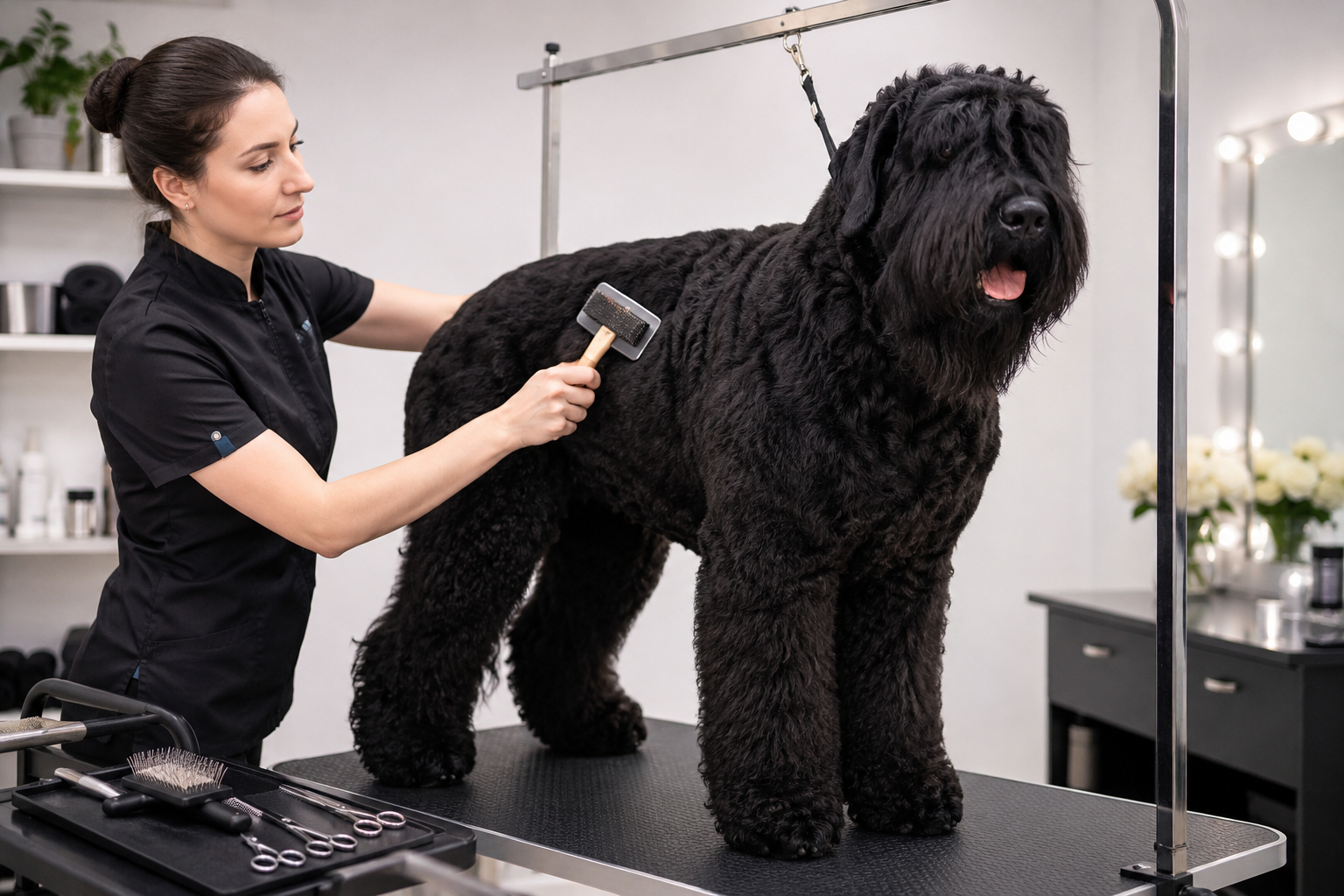
The Black Russian Terrier’s dense double coat is one of its most distinctive features — and one of its most demanding care requirements. Their coat does not shed excessively, but it mats quickly without regular attention [4].
Grooming schedule to follow:
- Brushing: Three to four times per week minimum, using a slicker brush and metal comb to work through the dense undercoat
- Professional trimming: Every 6–8 weeks to maintain the breed’s characteristic shape around the beard, ears, and paws
- Bathing: Every 4–6 weeks, or as needed after outdoor activity
- Ear cleaning: Weekly, as the beard and ear hair can trap moisture and debris
- Nail trimming: Every 3–4 weeks
Preventive care note: Matting around the beard and mustache is the most common grooming issue. Keep these areas clean and dry after meals and outdoor time to prevent skin irritation. For owners new to managing dense coats, our best dog brush for Goldendoodles guide covers brush types that also work well on thick double coats.
Common Health Problems in Black Russian Terriers
Black Russian Terriers are generally a sturdy breed, but they carry several breed-specific health risks that every owner should know. Their average lifespan is 10–12 years [4].
Key health concerns:
- Hip and elbow dysplasia: A common issue in large breeds. Ask breeders for OFA (Orthopedic Foundation for Animals) clearances on both parents.
- Bloat (Gastric Dilatation-Volvulus): A life-threatening condition where the stomach twists. Feed two smaller meals per day rather than one large meal, and avoid vigorous exercise immediately after eating.
- Progressive Retinal Atrophy (PRA): A degenerative eye condition that can lead to blindness. Genetic testing of breeding stock helps reduce risk.
- Hyperuricosuria: A genetic condition affecting uric acid metabolism, which can cause bladder and kidney stones.
A June 2026 study by the Veterinary Genetics Laboratory analyzed 176 Black Russian Terriers and identified predominant DLA Class I and II haplotypes, with DLA1 #1091 and DLA2 #2033 being the most common at frequencies of 50.9% and 51.1% respectively — findings that help guide responsible breeding decisions [1].
Preventive care checklist:
- Annual hip and eye evaluations from a veterinarian
- Genetic testing before purchasing a puppy
- Maintaining a healthy weight to reduce joint stress
- Regular dental care to prevent periodontal disease
How Much Does a Black Russian Terrier Puppy Cost?
A Black Russian Terrier puppy from a reputable breeder typically costs between $1,500 and $3,500 in the United States, with show-quality or titled-lineage puppies sometimes exceeding that range. Rescue adoption fees are generally $200–$500.
Beyond the purchase price, budget for:
- Initial vet costs: Vaccinations, microchipping, and a wellness exam ($200–$400)
- Spay/neuter: $300–$600 depending on location
- Food: A large breed diet for a 100-pound dog runs $80–$150 per month
- Grooming: Professional sessions every 6–8 weeks at $80–$150 per visit
- Training classes: $100–$300 for a basic obedience course
Choose a reputable breeder if: They health-test both parents, welcome visits to see the puppies with their mother, and are registered with the AKC or a recognized breed club. The AKC officially recognized the Black Russian Terrier in July 2004 [2], and breed club registries are a reliable starting point for finding ethical breeders.
Black Russian Terrier vs. Caucasian Shepherd: Key Differences
Both the Black Russian Terrier and the Caucasian Shepherd are large, protective dogs with Soviet-era working origins, but they differ significantly in temperament, trainability, and suitability as family dogs.
| Feature | Black Russian Terrier | Caucasian Shepherd |
|---|---|---|
| Origin | USSR (military breeding program) | Caucasus Mountains (livestock guardian) |
| Size | 80–130 lbs | 100–200+ lbs |
| Trainability | High — responds well to positive training | Lower — more independent and stubborn |
| Family friendliness | Good with proper socialization | More challenging; better for experienced owners |
| Stranger aggression | Aloof but manageable | Can be strongly territorial |
| Coat maintenance | High — regular brushing and trimming | High — dense coat requires frequent brushing |
| AKC recognition | Yes (2004) | Yes (FSS program) |
Choose a Black Russian Terrier if you want a trainable, family-oriented guardian dog. Choose a Caucasian Shepherd if you need a livestock protection dog and have extensive large-breed experience. For those exploring other large, powerful breeds, our Siberian Husky breed guide offers another perspective on Russian-origin working dogs.
Frequently Asked Questions About the Black Russian Terrier
Is the Black Russian Terrier a good dog for first-time owners?
Generally, no. This breed’s size, protective instincts, and need for consistent training make it better suited to experienced dog owners. A first-time dog owner who is committed to professional training classes and early socialization can succeed, but it requires extra effort.
Do Black Russian Terriers shed a lot?
Despite their thick double coat, Black Russian Terriers do not shed excessively. However, their coat mats easily without regular brushing three to four times per week [4].
How much exercise does a Black Russian Terrier need daily?
Plan for at least 60–90 minutes of exercise per day. This should include structured walks plus interactive play or off-leash running. Mental stimulation — through training, puzzle toys, or scent work — is equally important [4].
Are Black Russian Terriers good with other dogs?
With proper socialization from puppyhood, most Black Russian Terriers coexist well with other dogs. Same-sex aggression can occur, particularly in males, so early exposure to other dogs is important.
What is the Black Russian Terrier’s lifespan?
The average lifespan is 10–12 years [4]. Preventive care, a healthy diet, and regular veterinary checkups support longevity.
Is the Black Russian Terrier hypoallergenic?
No. While they shed less than many breeds, they are not hypoallergenic. Their dense coat still produces dander, which is the primary allergen for most people.
How long does it take to groom a Black Russian Terrier?
A thorough brushing session takes 20–30 minutes. Professional grooming appointments, which should happen every 6–8 weeks, typically last 2–3 hours.
Can Black Russian Terriers handle cold weather?
Yes. Their weatherproof, water-repellent double coat was specifically developed for cold Russian climates [8]. They handle cold weather better than heat.
At what age should training begin for a Black Russian Terrier?
Start basic commands and socialization as soon as your puppy comes home, typically at 8 weeks. The critical socialization window closes around 16 weeks, so early exposure is essential.
Are Black Russian Terriers recognized by the AKC?
Yes. The AKC officially recognized the Black Russian Terrier in July 2004, classifying it within the Working Group [2].
Conclusion
The Black Russian Terrier is one of the most capable, loyal, and impressive working breeds available to dog owners in 2026. This is a dog built for purpose — intelligent, protective, and deeply bonded to its family. But that same intensity means it is not the right fit for every household.
Actionable next steps for prospective owners:
- Research breeders carefully. Look for health-tested parents, AKC registration, and transparent breeding practices. Visit in person before committing.
- Enroll in obedience classes early. Sign up for a puppy class before your dog even comes home so you are ready from day one.
- Plan your grooming budget. Factor in professional grooming every 6–8 weeks as a non-negotiable ongoing cost.
- Schedule a pre-purchase vet consultation. Discuss breed-specific health risks like hip dysplasia and bloat with your veterinarian before bringing a puppy home.
- Commit to daily exercise. Identify parks, trails, or dog-friendly spaces near your home where your dog can get adequate physical activity.
If you are a seasoned canine enthusiast looking for a devoted, protective companion that will rise to the challenge of consistent training and care, the Black Russian Terrier may be exactly the furry friend you have been searching for. For more comprehensive profiles of working and guardian breeds, explore our full Russian dog breeds guide.
References
[1] Stats – https://vgl.ucdavis.edu/canine-genetic-diversity/black-russian-terrier
[2] AKC Approves Three New Dog Breeds – https://www.akc.org/press-releases/akc-approves-three-new-dog-breeds
[3] Black Russian Terrier – https://www.akc.org/dog-breeds/black-russian-terrier/
[4] Black Russian Terrier – https://www.petmd.com/dog/breeds/black-russian-terrier
[5] Black Russian Terrier – https://en.wikipedia.org/wiki/Black_Russian_Terrier
[6] 5 Facts Black Russian Terrier – https://www.akc.org/expert-advice/lifestyle/5-facts-black-russian-terrier
[7] Black Russian Terrier – https://www.royalcanin.com/us/dogs/breeds/black-russian-terrier
[8] Black Russian Terrier – https://www.petfinder.com/dogs-and-puppies/breeds/black-russian-terrier